
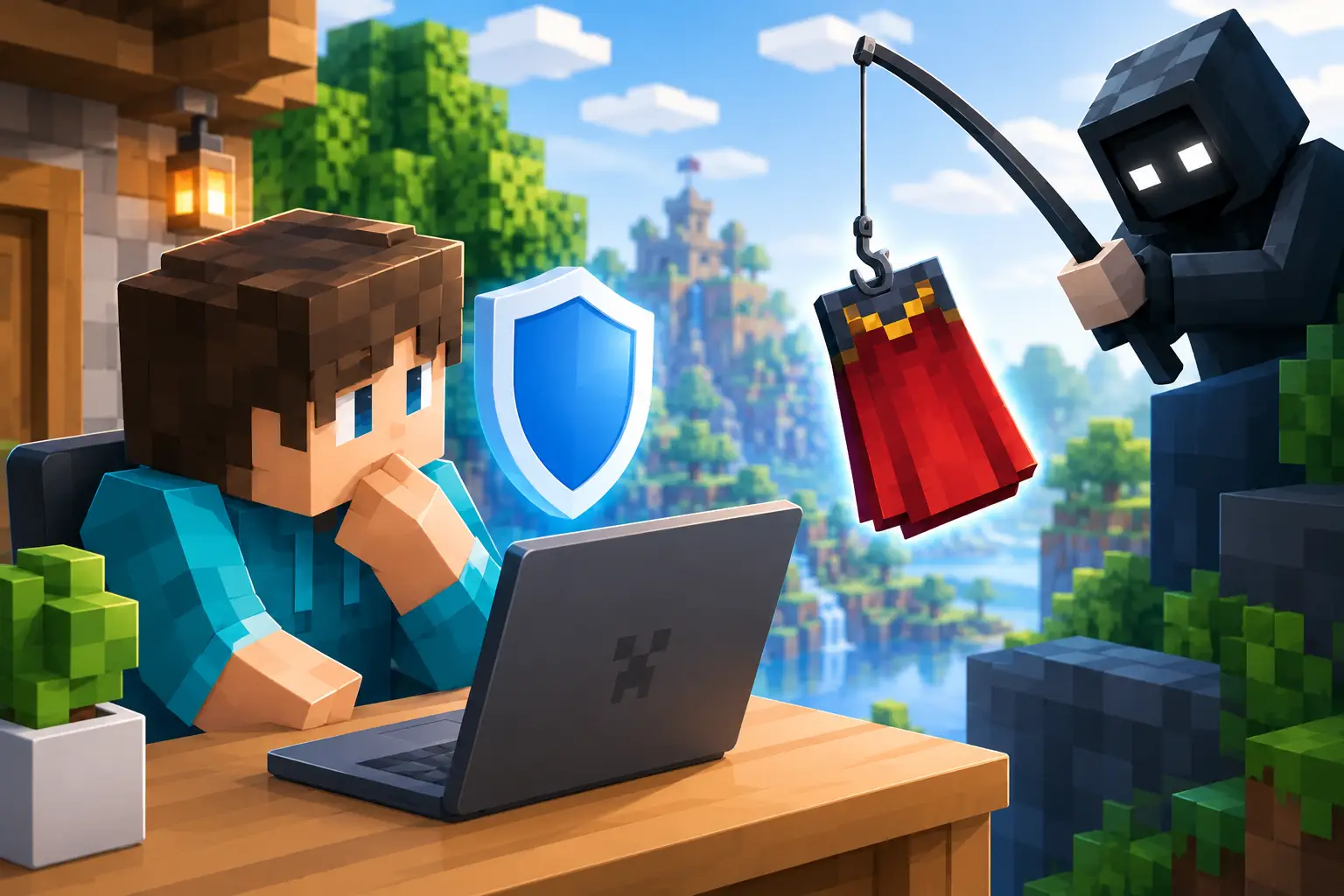
A rare cape can make a Minecraft account feel like a piece of game history. That value is exactly why scammers build convincing fake redemption pages, impersonate sellers, and push “limited” offers designed to rush collectors. To avoid Minecraft cape phishing, treat every unexpected cape offer as unverified until the seller, checkout, and redemption path all hold up.
A legitimate cape transaction should feel clear: you know what is being sold, how it will be delivered, where it is redeemed, and what support exists if something goes wrong. Phishing works by replacing that clarity with urgency, vague promises, and a login screen that is not actually connected to Microsoft or an official redemption flow.
Why Minecraft cape phishing works
Cape phishing does not always look like an obvious scam. A fake post may use screenshots of a real rare cape, a familiar-looking Minecraft logo, and comments from accounts that appear to be happy buyers. The goal is usually one of two things: steal your Microsoft account credentials or convince you to send money for a code that never arrives.
Collectors are especially attractive targets because rare capes are emotional purchases. A legacy cape, event cape, or limited cosmetic can disappear from public listings quickly, and scammers know that fear of missing out can override normal caution. “Only one left,” “redeem in the next ten minutes,” or “private seller needs payment now” are not proof of rarity. They are pressure tactics.
The most dangerous scams often offer a deal that is just believable enough. A price far below the market for a highly sought-after cape should make you slow down, not check out faster. Genuine sellers may price competitively, but they can still explain the item, the delivery process, and the buyer protections in plain language.
How to avoid Minecraft cape phishing before you pay
Start by separating a cape code sale from an account sale. A redeemable official code and a pre-owned account are fundamentally different purchases. Account transfers can create recovery disputes, violate platform rules, and leave the buyer exposed if the original owner later reclaims access. A code should not require your Microsoft password, your two-factor authentication code, or remote access to your device.
If a seller says they need to “verify” your account before sending a code, stop. Legitimate code delivery does not require your Microsoft login. Likewise, never send a screenshot of a security code, an email verification link, or a session token. Those details can give an attacker the final piece they need to take over an account.
Check the exact website address before entering payment or login information. Phishing domains commonly rely on small differences: an extra hyphen, a swapped letter, an unfamiliar ending, or a name that imitates a known marketplace. Do not trust a link simply because it arrived in a Discord message, a social media reply, a YouTube comment, or an email that looks polished on a phone screen.
A secure checkout is a useful signal, but it is not the whole test. Look for a store that clearly identifies what it sells, provides a real delivery process, and uses established payment handling rather than asking for cryptocurrency, gift cards, or payment sent as “friends and family.” Those payment methods are popular with scammers because reversing a fraudulent transaction is difficult or impossible.
Verify the offer, not just the screenshot
Screenshots are easy to copy. So are inventory images, cape renders, and proof-of-redemption messages. Instead of judging an offer by a single image, look for consistent details across the storefront: a specific product description, transparent code delivery terms, a working support route, and checkout information that matches the business identity.
For a code listing, ask practical questions. Is the cape described as an official redeemable code? Will the code be delivered directly by email after payment? Is the redemption destination explained without sending you to a suspicious login page? A seller who cannot answer these basics is not providing the confidence a collectible digital purchase deserves.
Verification also has limits. No marketplace can make a collectible risk-free, especially when an item is rare and supply is limited. The right standard is not blind trust. It is a transaction with enough traceability, clear expectations, and support that you are not relying on a stranger’s promise in a direct message.
Red flags that mean you should leave immediately
Some signals deserve an instant exit, not more negotiation. Watch for a seller who asks you to log into Microsoft through their site, claims your account must be “linked” to receive a cape, or sends a redemption page with a strange address. Official account sign-in should happen only through the genuine Microsoft flow, not through a page controlled by a cape seller.
Be equally cautious when someone pressures you to move off a marketplace. A scammer may say their store checkout is broken and ask you to continue on Discord, Telegram, Cash App, or crypto. Once the conversation moves into an unprotected payment channel, the seller has removed the very safeguards that make a transaction accountable.
Other serious warning signs include:
- A rare cape offered at a price that does not match its scarcity
- Requests for passwords, authentication codes, recovery codes, or screen sharing
- Payment instructions that require gift cards, crypto, or friends-and-family transfers
- A countdown timer or threats that the code will be given to another buyer immediately
- Poorly copied store pages with inconsistent names, spelling, or support details
One red flag may be enough to walk away. Several red flags are not a bargain waiting to happen. They are a scam getting closer to your account or payment details.
Protect your Microsoft account before and after buying
Your account security is more valuable than any individual cosmetic. Use a unique, long password for your Microsoft account and turn on two-step verification. If you use the same password across gaming services, change it. A cape phishing attempt can turn into a wider account compromise if the stolen login works elsewhere.
Keep your recovery email and phone number current, and review recent sign-in activity if you clicked a suspicious page or entered credentials anywhere questionable. Change your password directly through your normal Microsoft account route, not through a link sent by a seller. Sign out of unfamiliar sessions and remove any devices or app permissions you do not recognize.
If you already paid a suspicious seller, save the order details, receipts, usernames, messages, and screenshots before reporting the transaction through the payment provider. Do not keep arguing with the seller if they are demanding more money for a “release fee,” “verification fee,” or “code activation.” That is a common second attempt to extract more from a buyer who has already paid.
Choose a buying process built for collectors
For rare digital cosmetics, convenience matters, but traceability matters more. A strong buying process gives you a defined item, secure checkout, direct delivery, and a clear record of the transaction. It should never depend on handing over account access or trusting an anonymous profile with no meaningful accountability.
MineCapes.gg focuses on verified official cape code listings, secure Stripe checkout, instant email delivery, and tracked fulfillment because these details remove the uncertainty that scammers exploit. That does not mean buyers should stop checking product details. It means the purchase can be evaluated on a real storefront process rather than a rushed private message.
When a cape arrives, redeem it only through the stated official redemption route. Do not use a “special activation tool,” download a file to claim it, or install a browser extension offered by a seller. A legitimate code does not need software to prove it is real.
The best rare-cape purchase is not the one that creates the biggest rush. It is the one that leaves you with a verified collectible, a secure account, and a clean record of how it became part of your collection.