
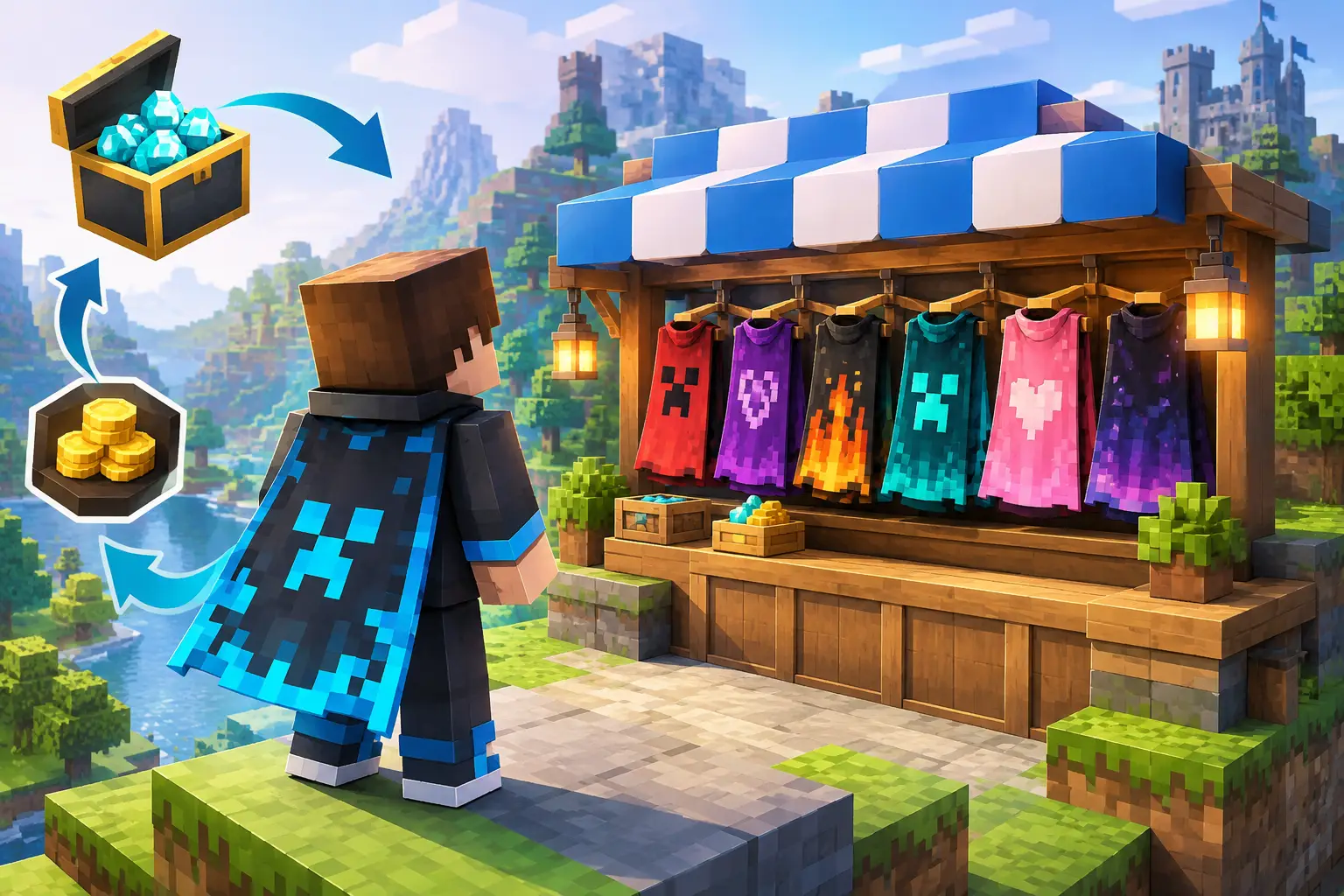
A rare cape is one of the few Minecraft cosmetics that can change how an account feels the moment it appears in-game. That is why the Minecraft cape market has grown beyond casual trading chatter. For collectors, a cape can represent a specific event, an early era of Minecraft, a limited promotion, or simply a piece of digital identity that almost nobody else has.
But rarity alone does not make a cape a smart purchase. The market has its own rules: code type matters, redemption status matters, provenance matters, and trust matters most. Knowing how those pieces fit together helps buyers avoid overpriced listings, unusable codes, and the risk that comes with informal account trades.
Why Minecraft Capes Carry Real Collector Value
Minecraft capes are unusually visible cosmetics. They are displayed on a player’s back across multiplayer servers, screenshots, videos, and skin viewers. Unlike a skin that can be copied in seconds, an official cape is attached to eligibility, a redemption code, or a specific account history. That limited access is what creates status.
The strongest collector demand usually centers on capes connected to one of three things: a historic moment, a restricted audience, or a short availability window. Minecon and community event capes have legacy appeal because they represent a time when access was limited by attendance or participation. Promotional capes can become desirable when the campaign ends and remaining redeemable codes become scarce. Migration, platform, and special recognition capes carry a different type of value because they may never have been offered through a standard public sale.
That does not mean every old cape rises in value forever. Demand changes with the community. A cape associated with a major anniversary, a recognizable event, or a popular design may attract more buyers than a rarer-looking cape with little story behind it. Collectors are buying the cosmetic, but they are also buying its place in Minecraft history.
The Minecraft Cape Market Is About Supply and Proof
The market is not one single pool of inventory. It includes untouched official code inventory, codes obtained through legitimate promotions, and capes already bound to accounts. These categories should never be treated as interchangeable.
A redeemable official code is generally the cleanest option for buyers because it can be redeemed to the buyer’s own eligible Minecraft account. Ownership stays where it should: with the person who purchased and redeemed the code. That is a much better outcome than buying an entire account, which can bring recovery disputes, security exposure, and possible violations of platform rules.
Proof is equally important. A screenshot of a code is not proof that it is valid, unused, or eligible for the intended redemption flow. A seller’s reputation alone is not enough either. In a category built around limited digital goods, a listing should be reviewed before it goes live, and buyers should receive clear information about what is being sold, how it is delivered, and what support is available if redemption does not go as expected.
This is where specialist marketplaces have an advantage over random direct messages or anonymous resale posts. A platform such as MineCapes.gg is designed around verified cape listings, secure Stripe checkout, tracked fulfillment, and instant email delivery. Those details are not just checkout features. They reduce the uncertainty that makes unverified cape trading risky.
What Actually Moves a Cape’s Price
Price is often the first thing buyers compare, but it is only one signal. Two listings for what appears to be the same cape can be priced differently for legitimate reasons. One could be a verified, untouched code with immediate delivery. The other could be an unclear offer involving an account, a delayed transfer, or no meaningful buyer protection.
Several factors usually shape market value:
- Scarcity: How many unused, redeemable codes are realistically still available?
- Demand: Is the cape widely recognized and actively sought by collectors?
- Condition: Is the code confirmed unused, complete, and ready to redeem?
- Origin: Does its promotional or event history give it collector credibility?
- Redemption certainty: Can the buyer clearly understand where and how the cape will be applied?
Scarcity deserves context. A cape may be rare because few were issued, but it can also be hard to find because remaining codes are sitting in private collections. Conversely, a cape can look scarce on a given day simply because few sellers are listing it. The lower number does not always mean the better long-term collectible.
For buyers, the useful question is not, “Is this the cheapest cape I can find?” It is, “What exactly am I receiving, and how much risk is attached to that price?” Paying slightly more for clear verification and a direct code delivery process can be the better value.
How to Buy a Cape Without Buying a Problem
Start by deciding whether you want a specific cape or are building a broader collection. If you have a dream cape in mind, research its origin and normal availability before purchasing. Learn whether it was distributed through an event, a promotion, or a recognition program. That background makes it easier to spot descriptions that do not add up.
Next, confirm the item format. For most buyers, an official redeemable code is preferable to account access. You should know whether the listing is for a single code, whether it is unused, and whether it is intended for Java Edition or another stated redemption path. If a seller cannot explain the item in plain language, stop there.
Then look at delivery and support. Digital delivery should be prompt, documented, and sent through a secure process. A trustworthy marketplace does not disappear once payment clears. It should provide order confirmation, fulfillment tracking, and a route to get help if there is a delivery or redemption issue.
Finally, redeem the code as soon as you receive it. Delaying redemption creates needless uncertainty. Use the official redemption instructions provided with your order, make sure you are signed into the correct account, and save your confirmation records. Once the cape appears on your account, you have completed the part that matters most: putting the collectible under your own control.
Red Flags Collectors Should Not Ignore
The fastest way to lose money in the cape market is to let urgency override basic checks. Rare inventory can move quickly, but “buy now or lose it forever” is also a classic pressure tactic.
Be cautious when a seller offers only account credentials, promises to transfer a cape later, asks for payment methods with no dispute protection, or avoids specific questions about code status. Be equally skeptical of prices far below the normal market range. A discount can be real, but a steep discount without a clear reason usually means the buyer is taking on risk the listing does not spell out.
Another warning sign is vague language. “Cape included,” “works for everyone,” and “limited account” do not tell you what you need to know. A good listing identifies the cape, explains the item being delivered, and sets realistic expectations around redemption. Collector-grade inventory should be described with collector-grade precision.
Collecting for Status, Not Just Speculation
Some buyers watch cape pricing closely, hoping a rare code will become more valuable later. That can happen, but speculation should be secondary to wanting the cape itself. The Minecraft community can shift quickly, and no cosmetic has a guaranteed future price.
The better collection strategy is personal. Choose capes that match your history with the game, your skin style, or the moments you want represented on your account. A legacy event cape can carry more satisfaction than a technically rarer cosmetic that means nothing to you. If its market value also holds up, that is a bonus rather than the entire reason to own it.
The best cape purchase is not the one that creates the loudest listing screenshot. It is the one you can redeem confidently, wear proudly, and recognize as a real piece of your Minecraft story.