
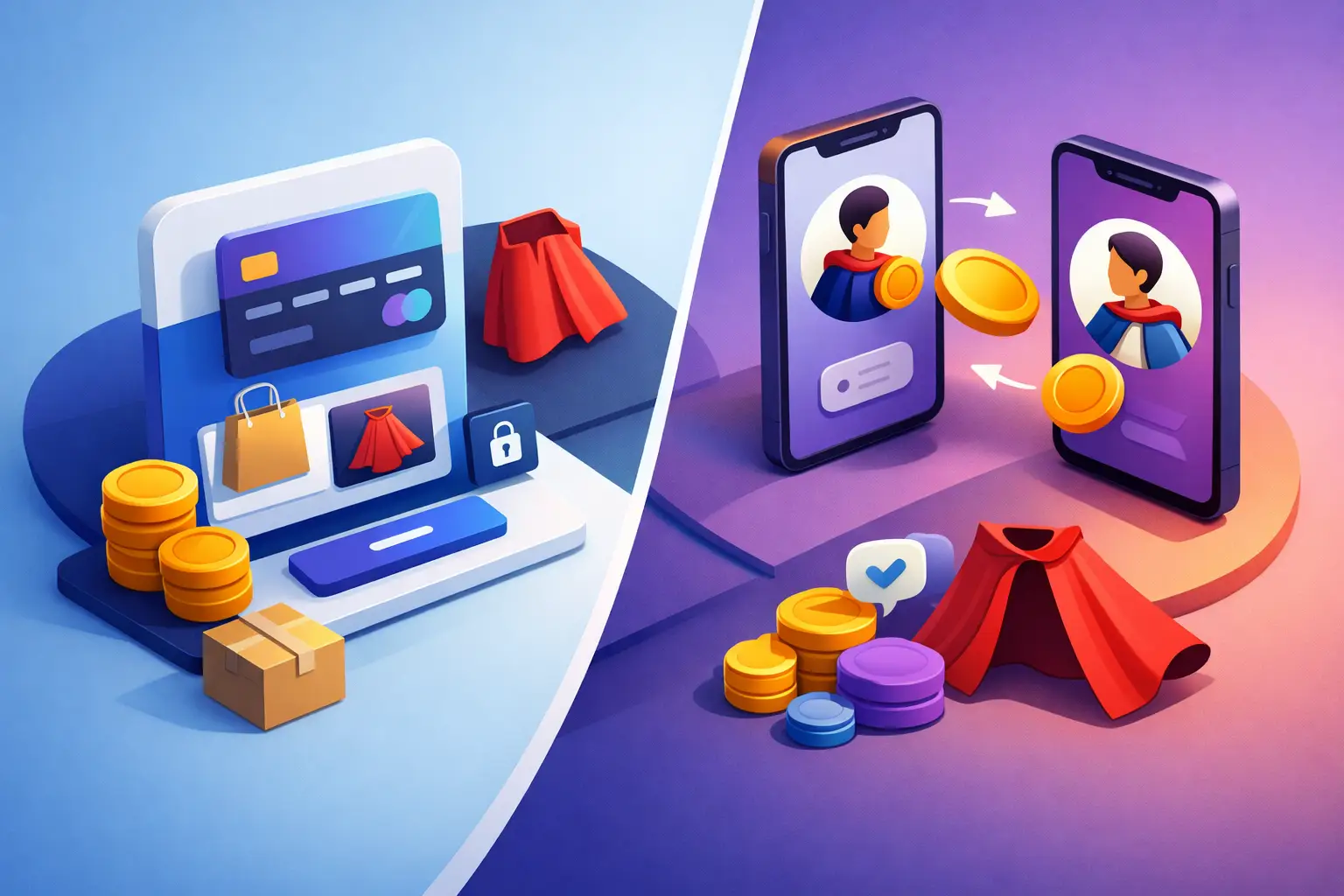
A rare Minecraft cape can be the final piece of a collection, a status item you have chased for years, or a gift that needs to land without drama. That is why stripe checkout versus peer payments is more than a payment preference. It changes how much visibility, documentation, and support you have if something goes wrong after money leaves your account.
For digital collectibles, the real purchase is not just a code. It is confidence that the code is official, unused, delivered promptly, and backed by someone accountable for the transaction. A proper checkout and an informal peer-to-peer deal can both end with a cape in your account. The difference is what happens when they do not.
Stripe Checkout Versus Peer Payments: The Core Difference
Stripe Checkout is the payment page used by an online business to collect a card payment through a structured storefront. You select the item, confirm the price, enter your details, receive an order confirmation, and the seller has an order record tied to the purchase. In a cape marketplace, that process can connect payment, inventory, delivery, and support in one place.
Peer payments are person-to-person transfers. Think of sending money directly to an individual after a Discord message, social post, private listing, or chat negotiation. These payments can feel quick, especially when a seller says they have a limited code and several buyers waiting. But the payment itself often sits outside any meaningful order system.
That distinction matters because a rare cape code is a digital item. There is no package arriving at your door and no physical product to inspect before you pay. The entire deal depends on the seller’s honesty, the code’s validity, and proof of what was promised.
Why a Storefront Checkout Gives Collectors More Control
A checkout flow does not automatically make every seller trustworthy. Collectors should still look at the product details, the marketplace’s focus, and whether the listing makes clear what is being sold. Still, a structured payment process gives you protections and records that a casual transfer usually does not.
A clear order trail
With checkout, there is a defined item, price, timestamp, receipt, and customer email attached to the order. That creates a shared reference point if you need help with delivery or redemption. If a code email is delayed, goes to spam, or needs to be resent, the support team can locate the purchase instead of asking you to prove a conversation happened in a crowded server.
In peer deals, the evidence may be scattered across screenshots, usernames that can change, deleted messages, and payment notes. Even when both parties mean well, resolving a simple mistake becomes harder when there is no consistent order record.
Better separation between payment and delivery
A professional digital-goods store can automate delivery after payment and track whether an order was fulfilled. For buyers, that usually means the cape code arrives at the email address used at checkout, with a reliable point of contact if it does not.
A peer seller may send a code manually after receiving funds. That leaves room for avoidable friction: they could be offline, forget the agreed delivery method, mix up buyers, or claim the code was already sent. Speed is not only about how fast you can send money. It is about how reliably you receive the item you paid for.
A payment page built for transactions
Stripe is widely used by online businesses to process card payments. Its checkout experience is designed for commerce, with payment confirmation and transaction records rather than the loose social context of a direct transfer. That is useful when the purchase has collector value and the item cannot be physically returned.
It also keeps the buying experience focused. You should be able to review the listing, pay through a recognizable checkout flow, and wait for delivery without handing over your personal social account, joining an unfamiliar group chat, or negotiating with a stranger.
Where Peer Payments Create Risk for Cape Buyers
Peer payments are not inherently bad. They can be practical between people who genuinely know and trust each other, particularly for low-stakes reimbursements. The risk rises when the recipient is an unknown seller offering a scarce digital collectible.
The most common issue is simple: a payment app confirms that money was sent, not that a valid cape code was delivered. A sender may see a completed transfer and assume the deal is protected. But the app’s confirmation often proves only the transfer itself.
Scammers use urgency to push buyers past that reality. You may see claims such as “first payment gets it,” “only accepting friends and family,” or “I cannot use checkout because of fees.” A rare-code market gives those lines extra pressure because no collector wants to miss a legacy cape. But a deal that cannot survive a few minutes of verification is not a deal worth rushing.
There is also the question of code provenance. A seller can show a screenshot of a cape, a redemption email, or an old event image without proving that the exact code they plan to send is legitimate and unused. Once a code has been redeemed, exposed, or sent to multiple people, there is no clean way to make that buyer whole through a private chat.
What to Check Before You Pay for a Cape Code
Whether you use a storefront or consider a private offer, slow down long enough to verify the basics. A high price does not prove rarity, and a low price does not automatically mean a bargain.
First, confirm the item description identifies the cape or code type accurately. Official redeemable codes should not be confused with account access, screenshots, cosmetic mods, or promises of a future transfer. Know exactly what will arrive in your inbox.
Next, check how delivery works. Is it instant email delivery after payment? Will you receive a receipt? Is there a stated process if the code does not arrive or cannot be redeemed? Those details tell you whether a seller has prepared for real customer support or simply expects the transaction to end once funds are sent.
Finally, look for accountability. A specialized marketplace has an incentive to protect its reputation, maintain accurate listings, and address a problem that could affect future buyers. That does not remove the need for care, but it is a stronger foundation than a one-time seller whose profile disappears after a transfer.
When Peer Payments May Still Make Sense
There are limited situations where a direct payment is reasonable. If you are buying from a close friend, can verify the code’s source, and accept the risks of the arrangement, a peer transfer may be the simplest option. The same may apply to established trading relationships where both people have a long, independently verifiable history.
Even then, do not confuse familiarity in a community with transaction protection. A recognizable username is not the same as a verified listing, an order receipt, and a support channel. For high-value capes, the stakes are too high to treat reputation alone as proof.
For most buyers, especially first-time collectors and gift buyers, checkout is the cleaner choice. It replaces a vague promise with an itemized order and a defined delivery path. MineCapes.gg is built around that model: verified cape listings, secure Stripe payment processing, and code delivery by email so the purchase does not depend on a stranger keeping their word in DMs.
The Better Question Is Not Just “Which Is Faster?”
Peer payments can take seconds. Stripe Checkout can also take seconds. The meaningful comparison is what each method leaves behind once the payment is complete.
With a proper checkout, you have an order confirmation, a declared product, a payment record, and a business that can investigate delivery or redemption issues. With an informal transfer, you may have a chat log and a hope that the other person responds. For a common item, some collectors may accept that trade-off. For a cape with real scarcity, legacy appeal, or gift value, it is usually the wrong place to cut corners.
Treat your payment method as part of authentication. Before chasing the next rare addition to your Minecraft collection, choose the option that gives your purchase a clear record, a real delivery process, and someone accountable after checkout.